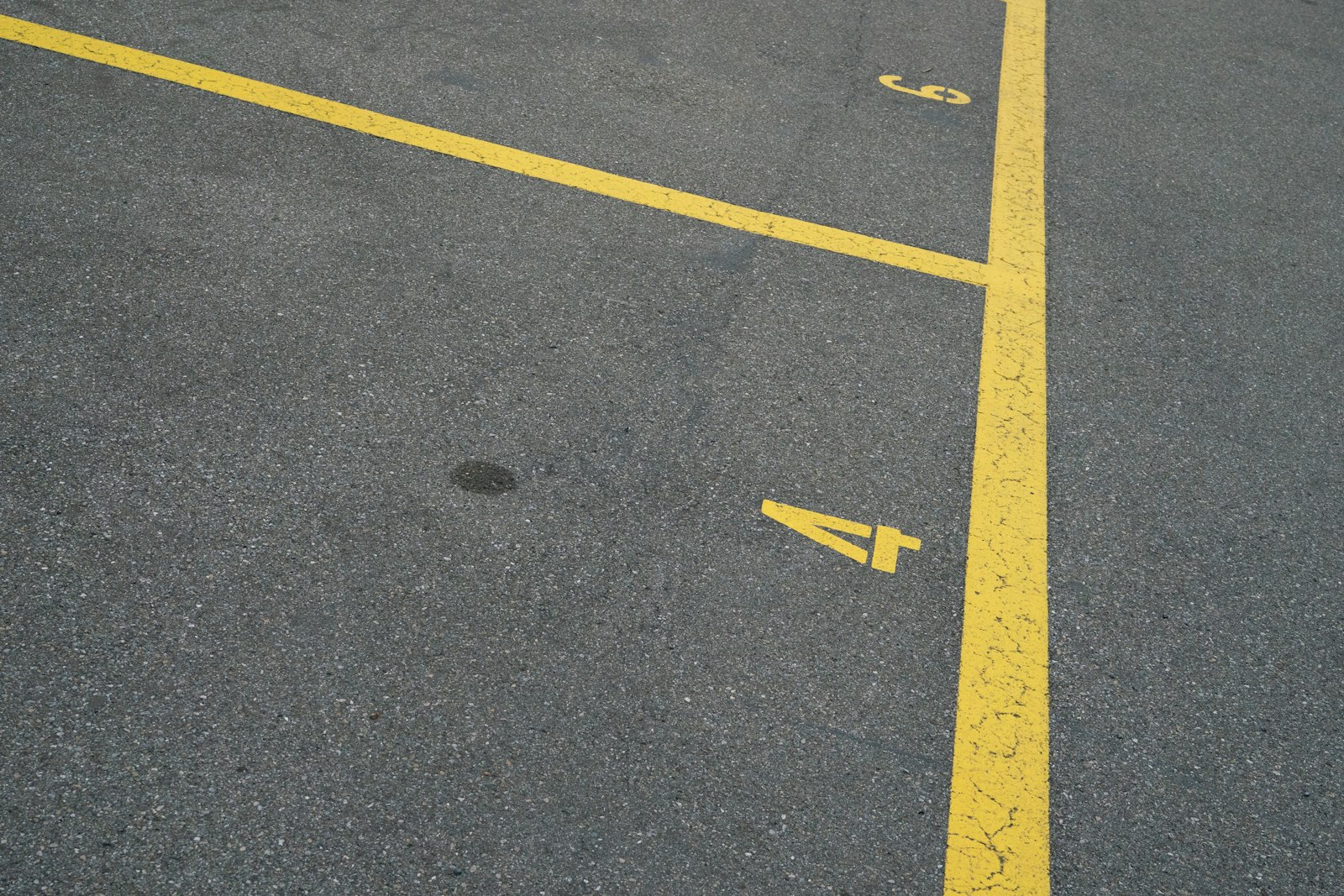
Car park bays, kerbs and pedestrian crossings need a paint that dries fast and stands up to tyres and fuel. Short answer: National Acrylic Road Marking is an acrylic-resin line paint that is touch dry in 5 to 10 minutes, does not bleed on asphalt, and resists water, oils and gasoline, according to National. Apply one or two coats on a clean, dry surface, and add glass beads for night-time reflection. This guide follows National Paints’ technical data sheet.
Key facts
| Type | Acrylic-resin road marking paint |
| Uses | Roadways, kerbstones, traffic crossings, airports, service stations and parking lots |
| Finish | Smooth matt |
| Colours on the data sheet | White, black, yellow |
| Volume solids | 42 ± 2% |
| Spreading rate | 4 to 8.5 m² per litre (theoretical) |
| Film per coat | 50 to 100 microns dry, depending on surface |
| Drying at 30°C | Touch dry 5 to 10 minutes; recoat after 30 minutes |
| Thinning | 5%, with National Acrylic Thinner |
| Application | Road marking machine, brush or roller |
| Shelf life | 18 months, sealed |
How to apply it
- Clean and dry the surface. Sweep away dust, sand and oil; the data sheet says to apply only on a clean, dry surface.
- Mask the lines with tape or use a line-marking machine for straight edges.
- Apply one or two coats, thinned up to 5% with National Acrylic Thinner. Wait 30 minutes between coats.
- Add glass beads for better reflection: drop them evenly onto the wet paint, or mix them in before applying, as National’s data sheet describes.
The data sheet does not give a time before vehicles can drive over the lines, so keep traffic off until the paint is fully hard.
How much to buy
A standard car park bay line 100 mm wide and 5 m long is 0.5 m². At 4 to 8.5 m² per litre, one litre marks about 8 to 17 such lines per coat, by our calculation. Rough asphalt sits at the low end of that range.
Frequently asked questions
Can I use it on concrete floors?
National lists roadways, kerbstones and parking lots. For warehouse and workshop floors, an epoxy floor system may suit better; see our epoxy floor guide and National epoxy floor systems.
Which thinner do I use?
National Acrylic Thinner, up to 5%. See which National thinner to use.
Step 1: prepare the surface
- National’s surface preparation guide asks for concrete that is clean, dry and sound, with laitance removed. Wash with high-pressure water (2200 psi minimum) and let it dry.
- Remove oil, rubber and loose old marking. Very smooth concrete should be acid-etched or roughened, per the same guide.
- Mask the line edges before painting by brush or roller.
What the numbers mean
Coverage = 42 × 10 ÷ 50 = 8.4 and 42 × 10 ÷ 100 = 4.2 m² per litre, matching the sheet’s 4 to 8.5. Rough asphalt or open concrete takes the heavier film.
Litres by line length
| Line (100 mm wide) | Area | Litres, 1 coat |
|---|---|---|
| 100 m of line | 10 m² | about 1.2 to 2.5 L |
| 500 m of line | 50 m² | about 5.9 to 12.5 L |
| 1 km of line | 100 m² | about 12 to 25 L |
Mistakes to avoid
- Thinning with water or G.P. Thinner. The sheet lists 5% National Acrylic Thinner.
- Marking damp or dusty concrete.
- Working near heat or flames. The flash point is below 32°C.
For high-visibility signs and kerb details, see National Fluorescent Paint.
Buy road marking paint in Sharjah and Dubai
Al Tashteb Al Saree is an authorised National Paints retailer. Shop Acrylic Road Marking Red 650, 0.9 L and Acrylic Thinner 3.6 L, or message us on WhatsApp for white, yellow and black.
Sources
- National Acrylic Road Marking data sheet (PDF, via AEC Online)
- National Paints surface preparation guide, Sec. A-2 (PDF)
Retrieved 3 November 2026. Quantities are our own calculations. The main image is illustrative.