If you have ever tapped a porcelain floor tile a year after handover and heard that dull, hollow sound, you already know what happens when the wrong tile adhesive goes onto a UAE site. Saving 6 or 8 dirhams a bag on a basic C1 mortar might look good on a quick quote—until 60×120 cm porcelain pops loose in a sunlit Sharjah villa or a bathroom wall starts tenting.
The good news is you do not need to guess or rely on brand names alone. Every compliant bag sold in the UAE carries a standard classification code—C1T, C2TE, or C2TE S1—under GSO EN 12004-1:2021 (the GCC adoption of EN 12004-1). Once you know how to read those letters, picking the right bag and working out how many 20 kg or 25 kg sacks to order takes two minutes.
In This Guide
30-Second Cheat Sheet: Which Grade for Which Job?
If you are standing in a hardware shop or checking a BOQ right now, here is the short version:
- Small interior ceramic tiles (up to 30×30 cm) on stable plaster or screed: Go with C1T.
- Interior porcelain (30×60 cm to 60×60 cm), bathrooms, kitchens, and retail floors: Use C2TE.
- Large-format porcelain (60×120 cm+), exterior façades, balconies, terraces, swimming pools, marble, or tile-over-tile: Step up to C2TE S1 (or C2TE S2 for high-rise cladding and heavy thermal movement).
Already know the grade you need? Plug your room area and trowel size straight into our Tile Adhesive Calculator and Tile Calculator to get your exact bag and box counts.
How to Read EN 12004 Codes on the Bag
Think of the code printed on the bag as a stack of upgrades. Every extra letter means the adhesive passed an additional lab test—so a C2TE S1 bag gives you improved bond strength (C2), non-slip wall hold (T), longer working time in heat (E), and flexibility (S1) all in one sack.
| Code | What It Means | EN 12004 Test Benchmark | Why It Matters on UAE Sites |
|---|---|---|---|
| C | Cementitious | Portland cement + polymers | Standard powder mixed with clean water on site. |
| 1 | Normal bond | ≥ 0.5 N/mm² tensile strength | Fine for porous ceramic indoors; too weak for dense porcelain. |
| 2 | Improved bond | ≥ 1.0 N/mm² tensile strength | Doubles minimum adhesion after dry, wet, and heat-ageing tests. |
| T | Reduced slip | ≤ 0.5 mm vertical slip | Stops heavy wall tiles from sliding down without props. |
| E | Extended open time | ≥ 30 minutes | Keeps the combed bed from skinning over in 35–45°C summer heat. |
| S1 | Deformable (flexible) | 2.5 to 5.0 mm bend | Absorbs thermal expansion between tile and concrete on exteriors and large slabs. |
| S2 | Highly deformable | ≥ 5.0 mm bend | Specified for high-rise exterior cladding and heavy movement zones. |
C1 vs C2TE vs C2TE S1: Where Each One Belongs
Why does porcelain demand C2 when ceramic works fine on C1? It comes down to water absorption. Standard clay ceramic is porous—cement paste soaks slightly into the biscuit and locks in mechanically. Porcelain is fired dense with less than 0.5% water absorption, so it relies on the polymer resin inside a C2 adhesive to grip the back of the tile.
Add direct UAE sun on a roof terrace or a 60×120 cm slab spanning a concrete floor, and the concrete and tile expand at different rates. That is where S1 flexibility prevents shear cracks and debonding.
| Specification | C1 / C1T | C2TE | C2TE S1 |
|---|---|---|---|
| Tensile Bond Strength | ≥ 0.5 N/mm² | ≥ 1.0 N/mm² | ≥ 1.0 N/mm² |
| Open Time | Standard (20 min) | Extended (≥ 30 min) | Extended (≥ 30 min) |
| Flexibility | Rigid | Rigid to semi-flexible | Deformable (2.5–5.0 mm) |
| Compatible Tiles | Porous ceramic only | Ceramic & porcelain (< 0.5% absorption) | Large porcelain, marble, granite, glass mosaic |
| Recommended Max Size | Up to 30×30 cm | Up to 60×60 cm | 60×120 cm and larger |
| Best UAE Applications | Budget dry walls, small ceramic | Villa floors, bathrooms, kitchens, offices | Pools, balconies, façades, tile-over-tile |
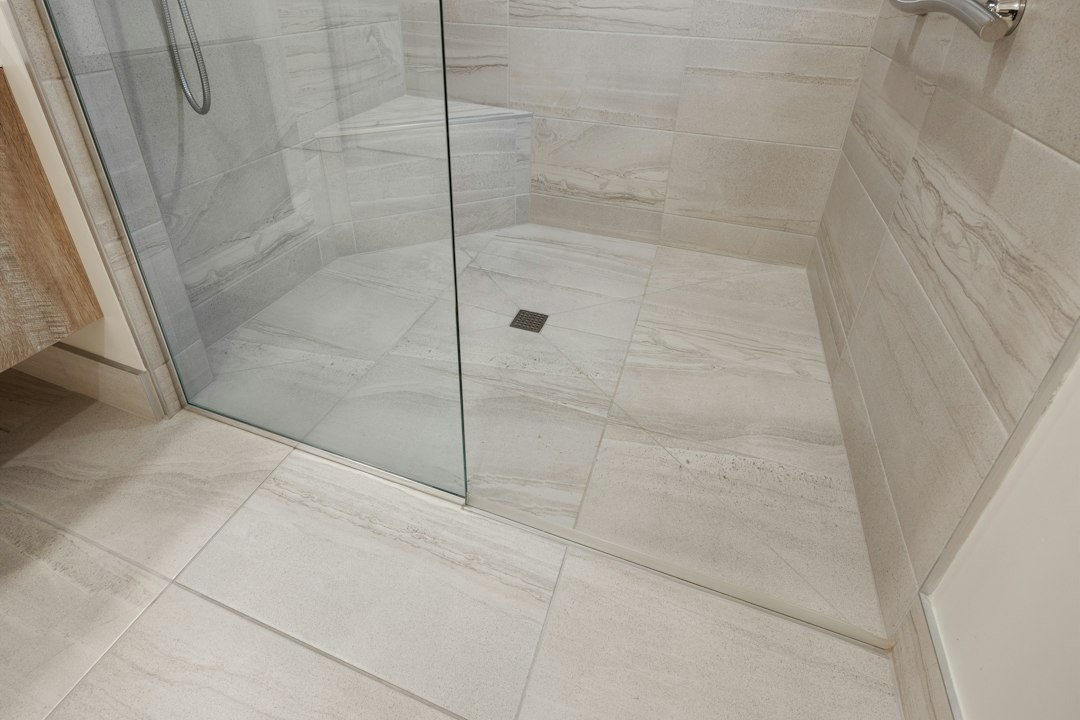
Wet-Area Reminder: Even a C2TE S1 adhesive is water-resistant, not a waterproofing membrane. Always apply a dedicated waterproofing coat under tiles in bathrooms, kitchens, and roofs. See our guides on roof and wet-wall waterproofing and gypsum board vs cement board for UAE showers. Specifying Terraco? Compare Terrafix W22 vs W11 or Terrapaste vs Maxi Tilepaste.
How Many Bags of Tile Adhesive Per m²?
Most tile adhesive in the UAE comes in 20 kg or 25 kg bags. How far one bag stretches depends on three things: your trowel notch size, how flat the screed is, and whether your tiler is back-buttering the tiles.
Use this quick reference table to estimate bag counts before wastage:
| Trowel Notch | Typical Tile Size | Coverage Rate | 10 m² (20 kg) | 25 m² (20 kg) | 50 m² (20 kg) | 50 m² (25 kg) |
|---|---|---|---|---|---|---|
| 6×6 mm | Small wall ceramic (≤ 20×20 cm) | 2.5 kg/m² | 2 bags | 4 bags | 7 bags | 5 bags |
| 8×8 mm | Medium ceramic (30×30 cm) | 3.2 kg/m² | 2 bags | 4 bags | 8 bags | 7 bags |
| 10×10 mm | Standard floor (30×60 / 60×60 cm) | 3.5 kg/m² | 2 bags | 5 bags | 9 bags | 7 bags |
| 12×12 mm | Large floor (60×60 cm+) | 4.5 kg/m² | 3 bags | 6 bags | 12 bags | 9 bags |
| 10–12 mm + Back-Butter | 60×60 / 60×120 cm porcelain | 6.5–7.0 kg/m² | 4 bags | 9 bags | 18 bags | 14 bags |
Real UAE Worked Example: 45 m² Villa Living Room (60×120 cm Porcelain)
Because the tiles are 60×120 cm porcelain, you need C2TE S1 applied with a 10–12 mm notched trowel plus back-buttering (~6.5 kg/m²).
- Base weight needed: 45 m² × 6.5 kg/m² = 292.5 kg
- Add 8% site allowance (minor floor dips & bucket waste): 292.5 × 1.08 = 315.9 kg
- 20 kg bags to order: 315.9 ÷ 20 = 15.8 → Order 16 bags (or 13 bags if buying 25 kg sacks).
Want to run your own room size and bag weight? Open our Tile Adhesive Calculator.
Watch out for uneven screeds: If your floor has 10–15 mm dips, do not let the tiler “pack it up” with extra tile adhesive. Thick blobs shrink as they cure, crack, and can double your bag bill. Fix low spots with a proper levelling screed or repair mortar first.
5 Site Mistakes That Cause Hollow Tiles in UAE Heat
Even a top-grade C2TE S1 bag will fail if the installation cuts corners. Watch for these five habits on site:
- Skipping back-buttering on 60×60 cm and 60×120 cm tiles. Combing the floor alone leaves air voids under large slabs. Trowel a thin, flat skim onto the back of every tile ≥ 60×60 cm (and all exterior tiles) before pressing it into the combed bed.
- Combing too much area in 40°C summer heat. Without an E (extended open time) adhesive—or if the tiler spreads 5 m² ahead—the surface forms a dry skin within minutes. Touch the ribs with your finger: if adhesive does not transfer to your skin, scrape it off and comb fresh mix.
- Tiling onto green concrete or dusty screed. Fresh screed shrinks as it cures. Wait the full 28 days on new slabs, sweep and vacuum all loose dust, and prime high-suction surfaces before starting.
- Using grey adhesive under white marble or light stone. Grey Portland cement bleeds through porous light marble and leaves permanent dark patches. Always specify White C2TE S1 for marble, travertine, and glass mosaic.
- Grouting the same afternoon. Trapping moisture under grout before the adhesive sets weakens the bond and causes efflorescence. Wait at least 24 hours before light foot traffic or grouting.
Frequently Asked Questions
Can I use C1 tile adhesive for porcelain tiles?
No. Porcelain has water absorption below 0.5%, so standard C1 cementitious adhesive cannot form a reliable bond. Always use at least C2TE for interior porcelain and C2TE S1 for large formats (60×120 cm+) or exterior areas.
What is the difference between C2TE and C2TE S1?
Both deliver the same high bond strength (≥ 1.0 N/mm²), slip resistance, and extended open time. S1 adds polymer flexibility (2.5–5.0 mm deformation) so the adhesive absorbs thermal expansion and structural movement without cracking—essential for UAE exteriors, terraces, pools, and large slabs.
How many square metres does one 20 kg bag of tile adhesive cover?
On a flat wall with a 6×6 mm notched trowel, one 20 kg bag covers about 8 m² (at 2.5 kg/m²). On 60×60 cm or 60×120 cm porcelain with a 10–12 mm notch plus back-buttering, expect roughly 3 m² per 20 kg bag.
Do I need a primer before applying tile adhesive?
On clean, cured cement screed or plaster, light dampening (with no standing water) is usually enough. You do need an acrylic bonding primer when tiling over gypsum boards, existing glazed tiles, or smooth/dusty concrete.
Need Tile Adhesive Delivered in Sharjah, Dubai or Ajman?
Browse our Adhesives & Sealants and Building Chemicals ranges, or send your tile size, area (m²), and site location on WhatsApp. Our shop in Bu Tina, Sharjah will reply with stock availability, AED prices (incl. 5% VAT), and delivery timing.