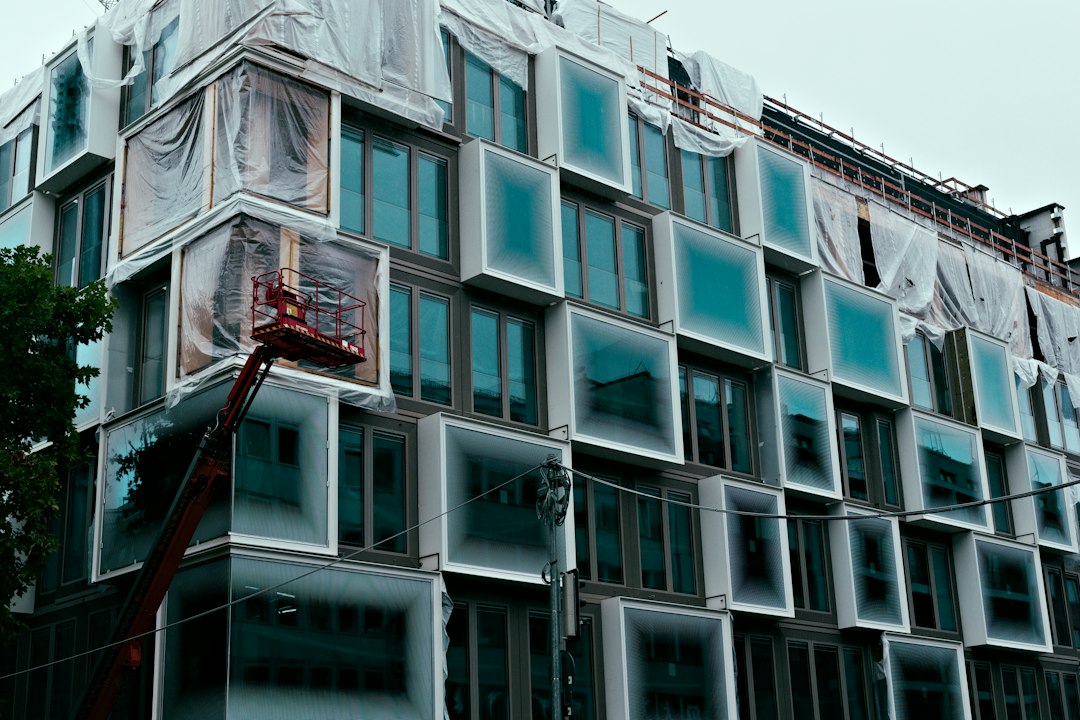
Short answer: EIFS (exterior insulation and finish system), also called ETICS, is insulation board fixed to the outside of a wall, covered by a base coat reinforced with glass-fibre mesh and finished with a decorative render or texture. In Dubai it cuts heat gain through walls and gives a seamless finish. Since the UAE Fire and Life Safety Code was updated in 2017, the whole facade system must pass fire tests (EmiratesGBC lists NFPA 285, NFPA 268 and ASTM E84) and be approved by Civil Defence, and the applicator must be approved too. In practice this pushed the market towards non-combustible mineral wool insulation for many buildings. Choose a complete, approved system, not a mix of parts. Here is how EIFS in Dubai works today.
Key points
- EIFS is a system: adhesive, insulation, anchors, base coat, mesh, primer and finish from one maker, tested together.
- Its job in the UAE is mostly to keep heat out. Insulation on the outside also shields the structure from daily temperature swings.
- Under the 2017 UAE fire code, facade components must reach Class A under ASTM E84, and systems are tested to NFPA 285 and NFPA 268, according to an EmiratesGBC workshop on the new rules.
- Dubai Civil Defence approves the system and the applicator; Dubai Municipality approval follows.
- Most failures are site failures: no mesh at corners, gaps between boards, bad sealing at windows, and finishing too soon.
How EIFS is built up, layer by layer
| Layer (from the wall out) | What it does | Common problems |
|---|---|---|
| 1. Prepared substrate | Block, concrete or plaster wall that is sound, flat and clean | Uneven walls force thick adhesive and gaps behind boards |
| 2. Adhesive | Bonds the insulation boards to the wall | Too little adhesive or only dabs, so air can circulate behind boards |
| 3. Insulation board | Slows heat flow into the building (EPS or mineral wool are the usual types) | Open joints between boards; boards not staggered |
| 4. Mechanical anchors | Secure the boards, especially at height and with heavy boards | Too few anchors, or anchors not set flush |
| 5. Base coat with glass-fibre mesh | The reinforced layer that resists cracking and impact | Mesh not overlapped, not fully embedded, or missing at corners |
| 6. Primer | Evens out suction and improves bond of the finish | Skipped to save time |
| 7. Finish coat | Decorative texture or render; first line of weather protection | Applied in direct sun or wind, leaving lap marks and cracks |
Why EIFS makes sense in the UAE climate
In a hot climate, most of the energy a building uses goes into cooling, and walls in direct sun soak up a great deal of heat. EmiratesGBC puts it simply: the building envelope “must be well insulated and air tight” to reduce heat gains, and Dubai’s Al Sa’fat and Abu Dhabi’s Estidama regulations set specific requirements for each envelope system.
Putting the insulation on the outside has some advantages over inside lining:
- It wraps columns and beams as well as the block, so there are fewer “thermal bridges” where heat bypasses the insulation.
- The structure stays at a more even temperature, which reduces thermal movement and cracking.
- No floor area is lost inside.
- The finish coat gives a continuous, crack-resistant facade.
One caution from the same EmiratesGBC workshop: cracks “might appear if ETICS is placed on columns and beams only”, so the system should cover the whole facade, not just the frame. The insulation thickness you need comes from the consultant’s energy calculation for the project, not from a rule of thumb.
The fire rules: what changed in 2017
After several high-profile facade fires, the UAE Fire and Life Safety Code was updated with much stricter rules for external walls. EmiratesGBC’s workshop summary on complying with the new Dubai Civil Defence codes sets out how this affects EIFS:
- Tests: “The required tests are NFPA 285, NFPA 268 and ASTM E84.” NFPA 285 is a large-scale fire test of a whole wall assembly; ASTM E84 measures surface flame spread on materials; NFPA 268 checks ignition from radiant heat.
- Class A: the code stops the use of system components that do not achieve Class A under ASTM E84.
- Registration: product registration “is a two-step process starting with DCD approval and ultimately followed by DM approval.”
- Applicators: “The applicator applying the system must also be approved by the DCD as well as the system manufacturer/supplier.”
- Insulation: mineral wool offers “improved fire resistance capabilities” compared with standard EPS systems. Several suppliers have since gained approval for mineral wool systems; Sto, for example, announced Abu Dhabi and Dubai Civil Defence approval for its StoTherm Mineral and StoTherm Classic S1 systems in 2019, after local testing to ASTM E84, NFPA 285 and NFPA 268.
What this means for you: before buying any EIFS materials, ask for the Civil Defence approval or listing of the exact system, check that it matches the building type and height in your project, and confirm the applicator’s own approval. A cheaper insulation board swapped in on site can invalidate the whole system.
EPS or mineral wool?
| EPS (expanded polystyrene) | Mineral wool | |
|---|---|---|
| Combustibility | Combustible plastic foam; relies on the tested system and fire barriers | Non-combustible |
| Weight | Very light | Heavier; needs more anchors |
| Handling | Easy to cut and rasp flat | Fibrous; needs care, PPE and dust control |
| Where you will see it | Systems and buildings where the approval allows it | Many systems approved under the stricter facade rules |
Site details that decide whether EIFS lasts
- Starter track at the base, level and fixed, with a drip so water runs off rather than into the system.
- Diagonal mesh patches at every window and door corner, where cracks start.
- Corner beads with mesh on external corners for impact resistance.
- Movement joints where the structure has them, carried through the system.
- Sealant joints at window frames, pipes and fixings, with the system’s approved sealant.
- Copings and sills that throw water clear of the face; EIFS should not be the top of a parapet.
- Weather: do not apply base coat or finish in direct midday sun, high wind or rain, and follow the drying times before overcoating.
- Fixings added later (AC brackets, signs, lights) need proper EIFS fixings and sealing, or they will let water in.
Maintaining an EIFS facade
Inspect sealant joints and corners every year, and repair cracks before water gets behind the mesh. When the colour fades, the finish can be repainted with a coating the system maker approves; ask before using a standard exterior paint, as some systems specify their own. Avoid high-pressure jets close to the surface when cleaning.
Terraco EIFS systems
We are an authorised Terraco distributor and stock Terraco’s EIFS range. Our guides compare the systems in detail: Terraco EIFS Alpha and EIFS Alpha vs Perma vs Polar. For your project, check the Civil Defence approval status of the specific system with us and with Terraco before ordering.
Questions we are often asked
Is EIFS the same as ETICS?
Yes, for practical purposes. EIFS is the American term and ETICS (external thermal insulation composite system) the European one. Both describe insulation board with a reinforced render on top.
Can I add EIFS to an existing villa?
Often, yes, if the wall is sound and the extra thickness can be detailed at windows, roof edges and boundaries. It still needs an approved system and applicator, and in some cases authority approval for facade changes.
How much does EIFS cost in Dubai?
It depends heavily on the insulation type and thickness, the finish, the height and access, and the approved system. We do not publish a single rate; send us the facade area and specification for a materials quote.
Planning an EIFS facade? Send us the drawings or the specification and we will help you match it to a Terraco system and price the materials. Message us on WhatsApp. Al Tashteb Al Saree Building Materials Trading, Bu-Tina, Sharjah.
Sources
- EmiratesGBC Technical Workshop, Fire Safety in Green Buildings: Complying with New DCD Codes (21 Feb 2018), PDF
- Sto, facade systems receive approved status for Abu Dhabi and Dubai Civil Defence (27 May 2019)
Retrieved November 2026. Rules and approvals change; confirm the current requirements with your fire consultant and Dubai Civil Defence before specifying.