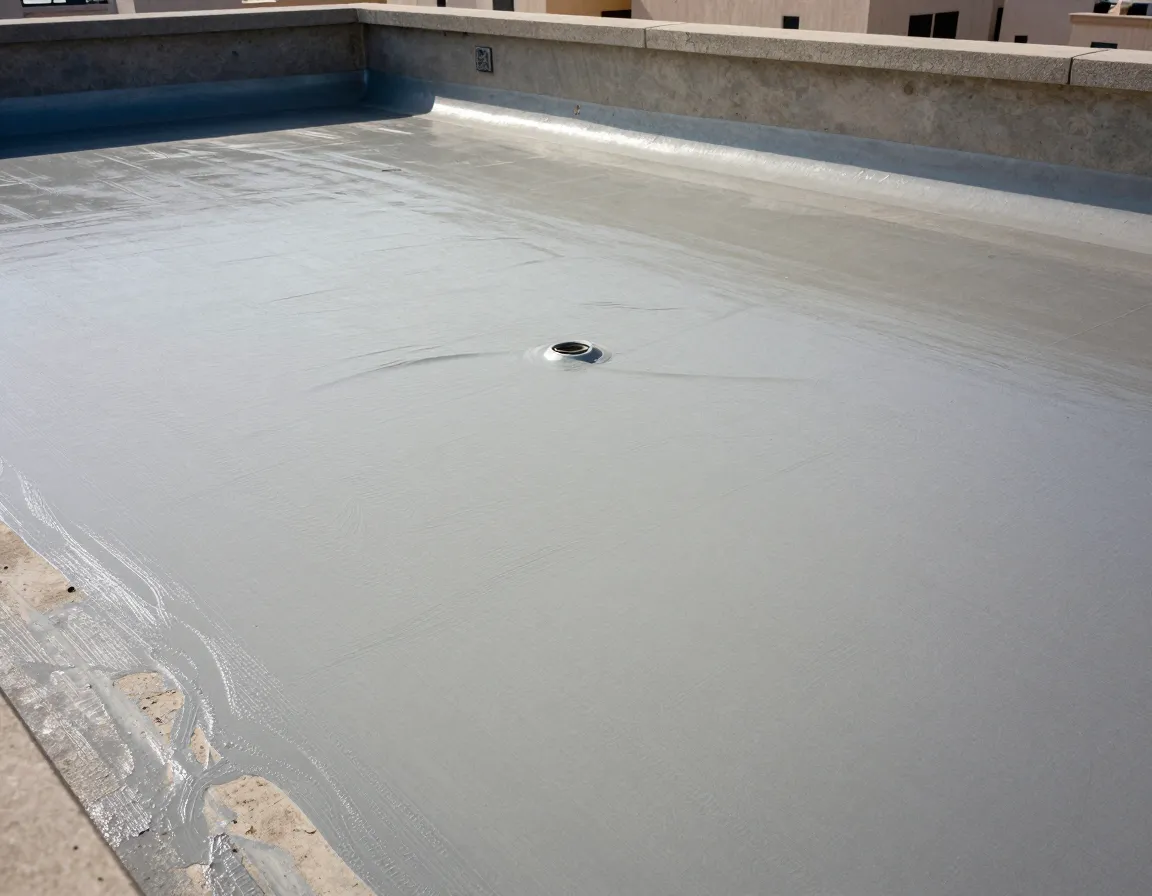
Step onto a villa flat roof or inspect a subterranean foundation raft in Sharjah, Ajman, or Dubai during a 24-hour flood test and you can spot a failed membrane installation before the water level even drops: dry, un-melted side laps you can pry open with a trowel blade, blisters puffing up over un-primed dusty screed, or low-softening-point bitumen slumping down a hot parapet upstand in 50°C August sun. Choosing the wrong torch-on waterproofing membrane UAE suppliers stock—or under-ordering 1 m × 10 m rolls by forgetting lap and upstand allowances—turns a one-day waterproofing stage into a costly tear-out.
In the UAE, reinforced bituminous waterproofing sheets and their solvent primers are governed by GSO EN 13707:2008 (Flexible sheets for waterproofing — Reinforced bitumen sheets for roof waterproofing), ASTM D6164 (Standard Specification for SBS Modified Bituminous Sheet Materials Using Polyester Reinforcements), and ASTM D41/D41M (Standard Specification for Asphalt Primer Used in Roofing, Dampproofing, and Waterproofing). Here is how to choose between APP (plastomeric) and SBS (elastomeric) 4 mm membranes, verify 180 g/m² vs 250 g/m² polyester core weights, and calculate exact roll and 20-litre primer drum quantities.
In This Guide
- Quick-Answer Cheat Sheet: UAE 4 mm Torch-On Membrane Specs & Coverage
- APP vs SBS Modified Bitumen Membranes: Technical Comparison Table
- Surface Finishes (PE Film, Sand & Slate) & ASTM D41 Bitumen Primer Rules
- Worked UAE Quantity Calculation: 220 m² Villa Flat Roof + Parapet Upstands
- 5 Common Torch-On Membrane Mistakes on UAE Sites (And How to Avoid Them)
- Frequently Asked Questions (FAQs)
Quick-Answer Cheat Sheet: UAE 4 mm Torch-On Membrane Specs & Coverage
- Standard UAE Roll Dimensions: 1.0 m wide × 10.0 m long = 10.0 m² gross area per roll, normally specified in 4.0 mm thickness (~40–45 kg per roll for plain/sand finish; ~45–50 kg per roll for 4.5 kg/m² mineral slate cap sheets).
- Effective Net Coverage per 10 m² Roll (The 8.5 m² Rule): With mandatory 100 mm side laps and 150 mm end laps, one 1.0 m × 10.0 m roll covers 0.90 m × 9.85 m = 8.865 m² net. Once you include corner gussets and cutting waste, always budget ~8.5 m² of net flat area per roll (or multiply total net m² including upstands by 1.18).
- APP Modified Bitumen (Plastomeric — High Heat): Softening point ≥ 150°C to 155°C. The top choice in the UAE for flat roofs, sun-baked parapet upstands, balconies, and wet areas because it resists thermal sagging in 50°C Gulf summer heat.
- SBS Modified Bitumen (Elastomeric — High Flexibility): Rubber-modified binder with high elongation and crack-bridging ability (ASTM D6164). Preferred for buried substructure tanking (raft blinding, pile caps, retaining walls) where soil temperatures are stable and structural settlement flexibility is critical.
- ASTM D41 Solvent Bitumen Primer Coverage: Brush or roll at 0.20 to 0.30 Litres/m² onto dry, dust-free concrete. One 20-litre drum (or 15 kg pail) covers approximately 65 to 85 m² and must dry tack-free (2–4 hours) before torching.
APP vs SBS Modified Bitumen Membranes: Technical Comparison Table
Both APP and SBS membranes start with distilled penetration-grade bitumen reinforced with a non-woven spunbond polyester carrier (typically 180 g/m², 200 g/m², or 250 g/m² under GSO EN 13707:2008). The difference lies in the polymer modifier blended into the bitumen—which completely changes how the roll behaves under a propane torch and in UAE summer temperatures:
| Technical Property | APP Modified Bitumen (Plastomeric) | SBS Modified Bitumen (Elastomeric) |
|---|---|---|
| Polymer Modifier | Atactic Polypropylene (thermoplastic resin) | Styrene-Butadiene-Styrene (synthetic rubber) |
| Primary Reference Standard | GSO EN 13707 / ASTM D6222 | GSO EN 13707 / ASTM D6164 / EN 13969 |
| Ring & Ball Softening Point | ≥ 150°C – 155°C (resists extreme UAE roof heat) | ≥ 115°C – 125°C (melts faster under light torching) |
| Heat Flow Resistance (2 hrs) | No flow or slippage at 120°C – 130°C | No flow at 95°C – 105°C |
| Elongation at Break (Polyester Core) | 35% – 45% (Longitudinal / Transverse) | 45% – 60% (elastic recovery after joint movement) |
| Standard UAE Carrier Weights | 180 g/m² (roofs/wet rooms) or 200 g/m² | 200 g/m² or 250 g/m² (substructure tanking) |
| Best UAE Site Application | Flat villa roofs, terraces, wet areas, hot parapet upstands | Basement raft tanking, pile caps, retaining walls, planters |
Site & QA/QC Warning: Never Torch Directly onto a 90° Concrete Wall-to-Slab Corner
A 4 mm polyester-reinforced membrane cannot bend sharply into a 90° internal junction between a horizontal roof slab and a vertical parapet wall. If forced into a right angle, a hollow air void stays trapped behind the bend and punctures as soon as the protection screed or roof tiles are laid. Always trowel a 50 mm × 50 mm (or 45° chamfered) sand-cement angle fillet reinforced with SBR latex along every internal wall-to-floor perimeter before priming with ASTM D41 bitumen primer.
Surface Finishes (PE Film, Sand & Slate) & ASTM D41 Bitumen Primer Rules
Ordering “4 mm torch-on rolls” without specifying the top surface finish can stall your project if you plan to apply a cement protection screed or C2TE tile adhesive directly over the membrane:
- PE Film / Talc Top Finish (Black Smooth): Best when the membrane will be covered by a loose-laid 150–200 g/m² geotextile separation fleece, extruded polystyrene (XPS) thermal insulation boards, or a second torch-on layer in a two-ply basement tanking system.
- Fine Silica Sand Top Finish: Essential whenever a bonded cement-sand protection screed, vertical protection render on upstands, or bathroom floor bed will be laid directly on top of the membrane, as the embedded sand grains provide a mechanical key.
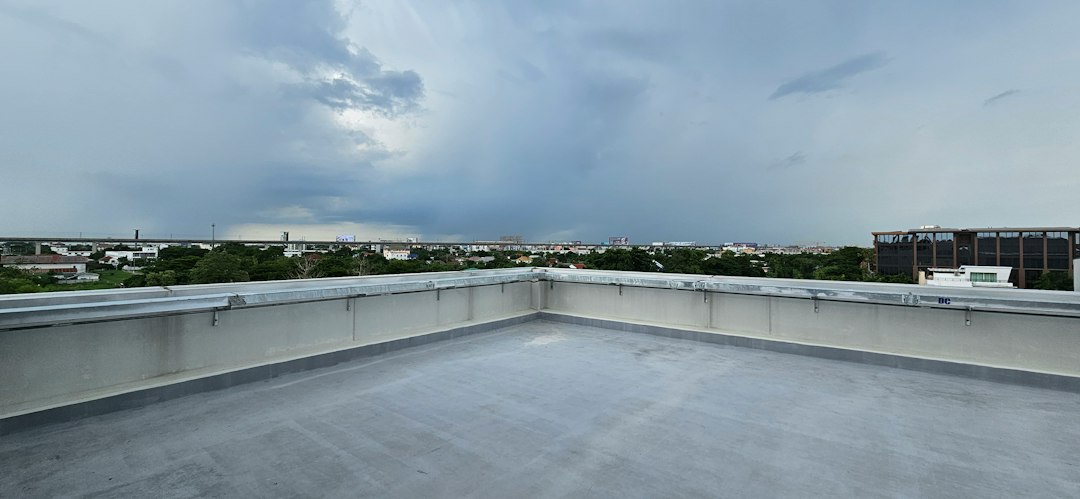
- Mineral Slate / Granule Cap Sheet (Grey, Green, or Red — 4.5 kg/m² to 5.0 kg/m²): Mandatory for exposed parapet upstands, non-accessible roofs, and skirting flashings where the membrane remains exposed to direct UV sunlight without a screed cover.
- Why ASTM D41 Solvent Primer Is Non-Negotiable: Concrete slabs cast from ready-mix concrete have microscopic surface dust and pores filled with air. Cold-applied ASTM D41 solvent bitumen primer penetrates 1–2 mm into the concrete pores and binds the dust so the molten torch-on bitumen fuses monolithically to the slab instead of floating on a layer of grey powder.
Worked UAE Quantity Calculation: 220 m² Villa Flat Roof + Parapet Upstands
Here is how a Quantity Surveyor calculates the exact order of 1 m × 10 m torch-on rolls, 20-litre ASTM D41 primer drums, and 50×50 mm fillet mortar for a standard villa roof in Sharjah or Dubai:
Worked Example: 220 m² Villa Roof Slab + 62 m Parapet Upstands (Single-Layer 4 mm APP Polyester Membrane)
Site Geometry: Net horizontal roof slab area = 220.0 m² (20.0 m × 11.0 m). Perimeter parapet & staircase wall length = 62.0 linear metres. Parapet upstand turn-up height = 300 mm above finished roof level (total vertical + 150 mm horizontal toe turn-out = 450 mm strip width). Specified laps = 100 mm side lap, 150 mm end lap.
- Step 1 — Main Horizontal Roof Rolls (4 mm APP Sand/PE Finish, 1 m × 10 m):
• Effective coverage per 10 m² roll after 100 mm side & 150 mm end laps = 0.90 m × 9.85 m = 8.865 m²/roll.
• Add 100 mm perimeter turn-up base + 5% cutting waste: 220.0 m² × 1.07 ÷ 8.865 m²/roll = 26.55 rolls → Order 27 rolls of 4 mm APP Plain/Sand Torch-On Membrane (1 m × 10 m). - Step 2 — Exposed Parapet Upstand Skirting Rolls (4.5 kg/m² Mineral Slate Finish):
• 62.0 m perimeter × 0.45 m unrolled upstand strip width = 27.9 m² net.
• Adding 150 mm lap every 1.0 m cut piece (+18% lap & corner gusset allowance) = 32.9 m² ÷ 10 m²/roll = 3.29 rolls → Order 4 rolls of 4 mm APP Mineral Slate Cap Sheet (1 m × 10 m). - Step 3 — ASTM D41 Solvent Bitumen Primer (at 0.25 L/m²):
• Total primed area (220 m² slab + 28 m² upstands = 248 m²) × 0.25 L/m² × 1.08 wastage = 67.0 Litres → Order 4 drums of 20-Litre ASTM D41 Bitumen Primer (80 L total). - Step 4 — 50×50 mm Cement-Sand Angle Fillet + Aluminium Counter-Flashing:
• 62.0 m of 50×50 mm chamfer fillet = 0.08 m³ mortar → 2 bags of 50 kg OPC Cement + 10 L SBR bonding agent.
• Termination bar at top of 300 mm upstand: 22 pcs of 3.0 m Aluminium Flashing Strip sealed with UV-resistant polyurethane mastic sealant.
Commercial Note: Membrane pricing in the UAE depends on carrier weight (180 g/m² vs 200 g/m² vs 250 g/m² spunbond polyester) and thickness (3 mm vs 4 mm). Verify your total quotation inclusive of tax with our UAE 5% VAT Calculator.
5 Common Torch-On Membrane Mistakes on UAE Sites (And How to Avoid Them)
- Torching Over Wet or Freshly Poured Concrete Screeds (Vapor Blistering): If you prime and torch a 4 mm membrane over a roof screed or concrete slab with more than 5–6% residual moisture, the UAE midday sun heats the trapped moisture into steam, blowing up football-sized blisters under the membrane. Allow fresh concrete or slope screeds to cure and dry, and test with a clear polythene patch taped down for 24 hours before priming.
- Under-Heating or Over-Burning the Polyester Core With the Propane Torch: A proper torch weld melts the bottom thermofusible PE film and creates a continuous 5 mm to 10 mm wave of molten black bitumen rolling ahead of the roll and squeezing out along every 100 mm side seam. However, holding the torch flame stationary in one spot burns right through the 180 g/m² polyester core, leaving the sheet brittle and weak.
- Aligning All End Laps in a Straight Line Across the Roof: Never line up the 150 mm end laps of adjacent membrane rolls side-by-side—this creates a four-layer-thick ridge (16 mm of bitumen) that traps ponding water and causes bridge voids. Always stagger end laps by at least 1.0 m to 1.5 m between neighbouring runs, starting from the lowest rainwater outlet and working upslope shingle-style.
- Leaving Parapet Upstand Tops Un-Clipped Without a Mechanical Termination Bar: Simply torching a vertical membrane strip onto a parapet wall without a chase groove and mechanical fixing fails within one summer: gravity and 50°C heat peel the top edge away from the wall, letting rainwater run behind the entire roof system. Always tuck the top edge into a 20×20 mm reglet groove or clamp it with a mechanically fixed aluminium counter-flashing bar and PU sealant.
- Skipping the 150–200 g/m² Geotextile Protection Layer Before Screeding or Backfilling: Dragging wheelbarrows, shovels, or sharp crushed aggregate over an unprotected 4 mm bitumen sheet punctures the membrane right before the flood test or backfill. Lay a non-woven geotextile protection fleece (or 3–4 mm bituminous protection board on basement walls) immediately after the flood test passes.
Frequently Asked Questions (FAQs)
How many square metres does one 1 m × 10 m roll of torch-on waterproofing membrane cover?
Although a standard roll measures 1.0 m × 10.0 m (10.0 m² gross area), UAE installation standards require a 100 mm longitudinal side lap and a 150 mm transverse end lap. That reduces the mathematical net coverage to 8.865 m² per roll. Once you account for corner gussets, drain collars, and cutting off-cuts, Quantity Surveyors calculate 8.5 m² of net flat coverage per roll (an ~18% overlap and waste factor).
Which is better for UAE roofs and foundations: APP or SBS torch-on membrane?
Use APP (Atactic Polypropylene) modified bitumen membrane for UAE flat roofs, terraces, balconies, and hot parapet upstands because its high softening point (≥150°C) prevents thermal flow and UV degradation under intense Gulf sunlight. Use SBS (Styrene-Butadiene-Styrene) rubber-modified bitumen membrane for buried substructure basement tanking, pile caps, and retaining walls where superior elongation and crack-bridging flexibility are required.
How much ASTM D41 bitumen primer is needed per roll of torch-on membrane?
ASTM D41 solvent bitumen primer is applied by brush or roller at a coverage rate of 0.20 to 0.30 Litres per m² depending on concrete porosity. That equals roughly 2.0 to 2.5 Litres of primer per 10 m² roll of membrane—meaning one standard 20-litre drum of bitumen primer primes enough substrate for 8 to 9 rolls (approx. 70–80 m² net).
How long is the mandatory flood test for torch-on roof waterproofing in Dubai and Sharjah?
Under Dubai Municipality and Sharjah consultant QA/QC procedures, completed roof and wet-area torch-on membranes must undergo a 24-hour to 48-hour continuous flood test with rainwater outlets plugged and the area filled to a 50 mm to 100 mm water depth (staying at least 50 mm below the top of the 300 mm parapet upstand termination) with zero drop in water level or soffit dampness.
Order 4 mm Torch-On Membrane Rolls, ASTM D41 Primer & Waterproofing Supplies in the UAE
Al Tashteb Al Saree Building Materials Trading (Bu Tina, Sharjah) supplies waterproofing contractors and villa projects across Sharjah, Ajman, and Dubai with 4 mm APP & SBS torch-on rolls, 20L ASTM D41 bitumen primers & building chemicals, PU flashing sealants & mastics, Terraco liquid waterproofing systems, and heat-resistant gloves & site safety PPE—all quoted in AED incl. 5% VAT.