Deliver white beaded Expanded Polystyrene (EPS) sheets to an inverted villa roof or basement retaining wall site in Dubai, Sharjah, or Ajman, and the consultant will reject the entire truckload before a single bundle is untied—or worse, if laid above the roof waterproofing membrane, the open-bead EPS boards will soak up rainwater like a sponge and lose half their thermal resistance. Even when contractors order the right closed-cell XPS insulation board UAE municipalities require, using solvent-based bitumen adhesive instead of water-based emulsion melts deep cavities right through the foam within minutes.
In the UAE, rigid cellular polystyrene thermal insulation boards are governed by GSO ASTM C578:2010 (ASTM C578-23: Standard Specification for Rigid, Cellular Polystyrene Thermal Insulation) and GSO ISO 4898:2024 (Rigid cellular plastics — Thermal insulation products for buildings). Here is how to choose between XPS (Extruded Polystyrene) and EPS (Expanded Polystyrene), select the required 50 mm, 75 mm, or 100 mm thickness to pass UAE green building U-value limits (≤ 0.30 W/m²·K), and calculate exact 1,250 × 600 mm board and bundle quantities.
In This Guide
- Quick-Answer Cheat Sheet: UAE XPS vs EPS Roof & Wall Insulation Rules
- XPS vs EPS Thermal Insulation Boards: GSO ASTM C578 Technical Comparison
- UAE Roof U-Value Rules: Choosing 50 mm, 75 mm, or 100 mm XPS Thickness
- Worked UAE Quantity Calculation: 240 m² Villa Inverted Roof (75 mm XPS)
- 5 Common XPS Insulation Mistakes on UAE Sites (And How to Avoid Them)
- Frequently Asked Questions (FAQs)
Quick-Answer Cheat Sheet: UAE XPS vs EPS Roof & Wall Insulation Rules
- Standard UAE XPS Board Size: Most GCC-manufactured extruded polystyrene boards measure 1,250 mm × 600 mm (0.75 m² per board) or 1,200 mm × 600 mm (0.72 m² per board) with 15 mm shiplap (rebated) edges on all four sides to eliminate thermal bridging.
- Why XPS Is Mandatory on UAE Flat Roofs & Basements: Because XPS is extruded with a 99% closed-cell structure, its water absorption by total immersion is ≤ 0.3% by volume (ASTM C578 Type IV / VI / VII), allowing it to sit directly above the roof waterproofing membrane in an inverted roof without absorbing rainwater.
- Where EPS (Expanded Polystyrene) Is Used: Molded white or grey graphited EPS (ASTM C578 Type I / II / VIII, 15–25 kg/m³) is breathable and economical, making it the standard core for external wall EIFS facade systems, insulated concrete sandwich blocks, and void formers—never for wet inverted roofs or high-load floors.
- Compressive Strength Classes (at 10% Deflection):
• 250–300 kPa (32–35 kg/m³ density, ASTM C578 Type IV / VI): Standard non-accessible & tiled villa flat roofs and basement perimeter wall protection.
• 400–500 kPa (38–42 kg/m³ density, ASTM C578 Type VII): Rooftop car parks, heavy chiller equipment plinths, and industrial cold-storage floors. - Thickness for UAE Roof Code Compliance (U ≤ 0.30 W/m²·K): With an aged thermal conductivity (λ) of 0.029 to 0.032 W/m·K, a 75 mm to 100 mm XPS board achieves a complete roof assembly U-value of 0.26 to 0.30 W/m²·K (meeting Dubai Al Sa’fat, Abu Dhabi Estidama, and Sharjah SEWA thermal rules).
XPS vs EPS Thermal Insulation Boards: GSO ASTM C578 Technical Comparison
Under GSO ASTM C578:2010 and GSO ISO 4898:2024, polystyrene boards are classified by density, compressive resistance, thermal conductivity, and water absorption. Use the table below to check material submittals before ordering:
| Property / Specification | EPS (Expanded Polystyrene) | Standard Roof XPS (300 kPa) | Heavy-Duty Floor XPS (500 kPa) |
|---|---|---|---|
| ASTM C578 Classification | Type I, II, or IX (Molded Beads) | Type IV or Type VI (Extruded) | Type VII (High-Load Extruded) |
| Nominal Density (kg/m³) | 15 – 24 kg/m³ | 32 – 35 kg/m³ | 38 – 45 kg/m³ |
| Compressive Strength (10% Defl.) | 70 – 150 kPa | ≥ 250 – 300 kPa (~30 tonnes/m²) | ≥ 500 kPa (~50 tonnes/m²) |
| Thermal Conductivity (λ at 24°C) | 0.036 – 0.038 W/m·K | 0.029 – 0.032 W/m·K | 0.030 – 0.032 W/m·K |
| Water Absorption (ASTM C272) | 2.0% – 4.0% by volume (inter-bead voids) | ≤ 0.30% by volume (closed cell) | ≤ 0.30% by volume (closed cell) |
| Edge Profile | Square butt edge | 15 mm Shiplap (L-rebated edge) | 15 mm Shiplap (L-rebated edge) |
| Approved UAE Applications | Facade EIFS, block cores, expansion joints | Inverted flat roofs, terraces, basement wall protection | Rooftop parking decks, cold store slabs, under-raft slabs |
Site & Chemical Warning: Solvent Bitumen Primers Dissolve Polystyrene Instantly
Never spot-glue XPS or EPS insulation boards onto basement retaining walls using solvent-based bitumen primer (ASTM D41) or contact adhesives containing toluene, xylene, or acetone. Hydrocarbon solvents chemically melt polystyrene into a shrunken sticky residue within minutes. Always bond XPS boards to vertical basement waterproofing using solvent-free, water-based bituminous emulsion, polyurethane foam adhesive, or cementitious polymer adhesive—and on flat roofs, loose-lay the XPS boards dry over a geotextile separation sheet.
UAE Roof U-Value Rules: Choosing 50 mm, 75 mm, or 100 mm XPS Thickness
In the UAE, nearly 60% of a villa’s summer air-conditioning load enters through the flat concrete roof slab if the insulation thickness is undersized. Here is how thickness translates into thermal resistance (R = Thickness m ÷ λ) and packed bundle quantities for standard 1,250 mm × 600 mm (0.75 m²) boards:
- 50 mm Thick XPS Board (R ≈ 1.65 m²·K/W): Packed 8 boards per bundle (6.00 m²/bundle). Commonly used as external mechanical protection and thermal insulation over basement retaining wall waterproofing before backfilling, or for roof extensions over unconditioned service rooms.
- 75 mm Thick XPS Board (R ≈ 2.50 m²·K/W): Packed 5 or 6 boards per bundle (3.75 m² or 4.50 m²/bundle). Combined with a 200 mm RC slab, foam concrete slope screed, and solar-reflective roof tiles, 75 mm XPS achieves a total roof U-value of ~0.30 W/m²·K, satisfying standard villa roof inspections in Sharjah and Ajman.
- 100 mm Thick XPS Board (R ≈ 3.33 m²·K/W): Packed 4 boards per bundle (3.00 m²/bundle). Delivers a roof U-value of ~0.24 to 0.26 W/m²·K, specified across Dubai Municipality Al Sa’fat Silver/Gold villa projects and commercial buildings to slash peak DEWA summer cooling bills.
Worked UAE Quantity Calculation: 240 m² Villa Inverted Roof (75 mm XPS)
Here is how a Quantity Surveyor calculates the exact number of 75 mm XPS boards and bundles, plus the two filter/separation geotextile layers required above and below the insulation on a 240 m² UAE villa roof:
Worked Example: 240 m² Villa Inverted Roof — 75 mm Shiplap XPS (32–35 kg/m³, 300 kPa)
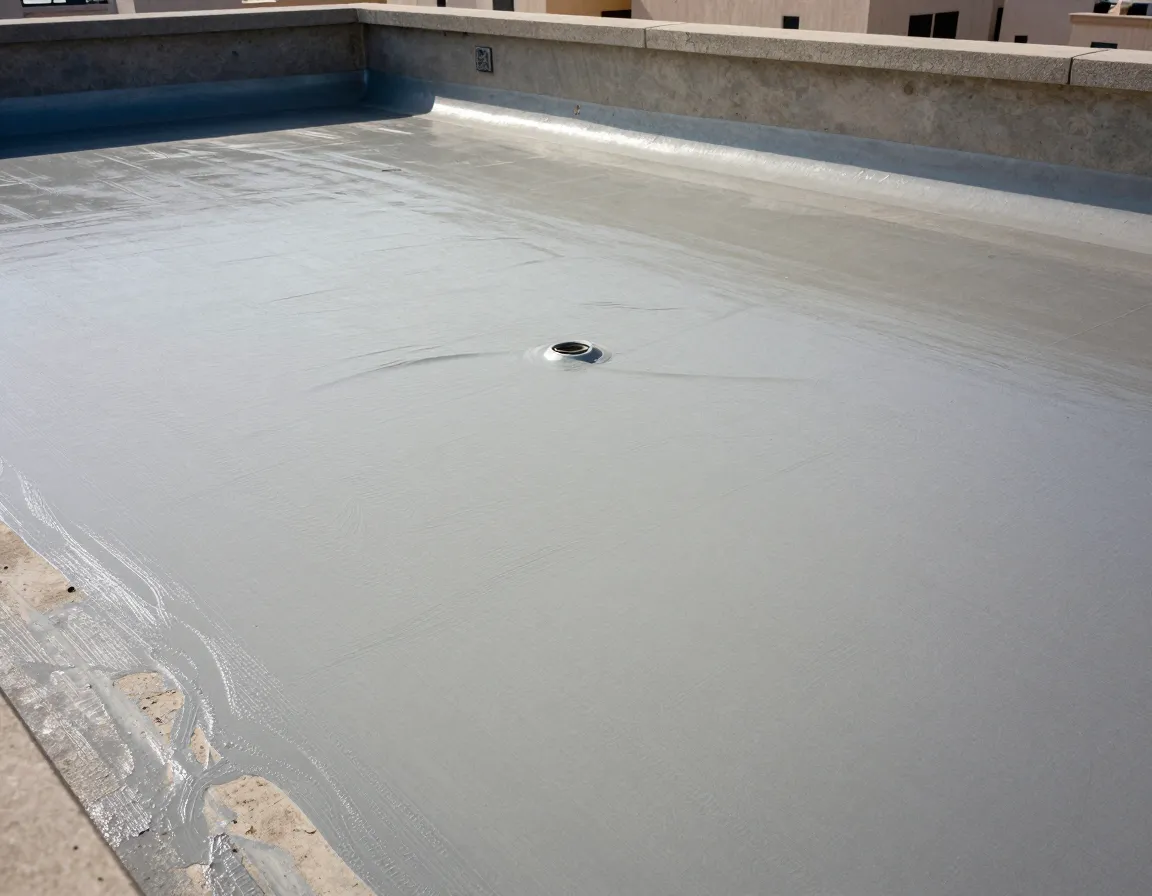
Roof Build-Up (Bottom to Top): RC Roof Slab → Foam Concrete Slope Screed → 4 mm Torch-On Membrane → 150 g/m² Geotextile Separation Layer 1 → 75 mm Shiplap XPS Insulation Boards (1,250 mm × 600 mm) → 150 g/m² Filter Geotextile Layer 2 → 50 mm Washed Gravel Ballast or Cement Screed + Roof Tiles.
- Step 1 — Net Coverage per Shiplap XPS Board:
• Nominal board size = 1,250 mm × 600 mm = 0.75 m² nominal (note: check if supplier quotes nominal 1,250×600 mm or net face after 15 mm shiplap rebate = 1,235×585 mm = 0.722 m² net). - Step 2 — Total Boards & Bundles (Including 5% Cutting Waste Around Parapets & Drains):
• Gross area required = 240.0 m² × 1.05 = 252.0 m².
• Number of boards (at 0.75 m²/board) = 252.0 ÷ 0.75 = 336 boards.
• Number of bundles (at 6 boards / 4.50 m² per 75 mm bundle) = 336 ÷ 6 = 56 bundles of 75 mm XPS (252 m² total). - Step 3 — Companion Geotextile Separation & Filter Rolls (2 m × 100 m = 200 m²/roll):
• Lower cushion layer (over waterproofing) + upper filter layer (preventing sand/fines from washing between XPS board joints) = 2 × 240 m² × 1.15 lap factor = 552 m² → Order 3 rolls of 150 g/m² Non-Woven Geotextile (600 m² gross).
Commercial Note: XPS boards are priced per cubic metre (m³) or per bundle depending on density (32 kg/m³ vs 35 kg/m³ vs 40 kg/m³). Here, 252 m² × 0.075 m thickness = 18.90 m³ of XPS. Check your total material cost inclusive of tax with our UAE 5% VAT Calculator.
5 Common XPS Insulation Mistakes on UAE Sites (And How to Avoid Them)
- Leaving Unballasted XPS Boards Exposed to Sun & Wind for Weeks: Lightweight 75 mm XPS boards weigh only ~2.5 kg each and degrade rapidly on the surface under intense UAE ultraviolet radiation (chalking yellow/dusty within 2–3 weeks). Even worse, a sudden afternoon wind gust will lift unballasted boards right off a 2nd-floor roof. Always cover and ballast XPS boards with geotextile, gravel, or protection screed within 48 hours of laying.
- Laying Square-Edge Boards with Continuous Straight-Through Joints (Thermal Bridges): Never lay XPS boards in a four-corner grid pattern where longitudinal and transverse joints align continuously. Always specify 15 mm shiplap (rebated) edge boards and lay them in a staggered running-bond (brickwork) pattern pushed tightly together so chilled room air cannot escape through joint gaps.
- Omitting the Top Filter Geotextile Fleece Above the XPS Boards: In an inverted roof, if you pour sand-cement tile bedding or gravel directly on top of XPS boards without a breathable filter geotextile membrane, fine sand and cement slurry wash down into the 1–2 mm board joints, locking the boards rigidly and blocking rainwater drainage channels across the waterproofing layer below.
- Using Low-Density 15 kg/m³ EPS Under Floor Screeds or Roof Walkways: White packaging-grade EPS crushes under wheelbarrow loads during screeding, causing your tiled roof floor or screed to crack along every board joint. Specify at least 250–300 kPa extruded XPS under roof screeds and 500 kPa XPS under vehicle or plant decks.
- Torching Parapet Flashings After XPS Boards Are Already Laid Against the Wall: Polystyrene melts at ~100°C and ignites easily if hit by a stray propane torch flame. Complete 100% of your torch-on membrane, parapet upstands, and 24-hour flood test before bringing a single bundle of XPS insulation onto the roof deck, and keep certified fire extinguishers and site safety gear on standby.

Frequently Asked Questions (FAQs)
What is the difference between XPS and EPS insulation boards in the UAE?
XPS (Extruded Polystyrene) is manufactured by continuous extrusion into a dense (32–42 kg/m³), 99% closed-cell board (typically blue, green, yellow, or pink) with high compressive strength (250–500 kPa) and near-zero water absorption (≤0.3%), making it mandatory for UAE inverted roofs, wet areas, and basement walls. EPS (Expanded Polystyrene) is molded from expanded white or grey beads (15–25 kg/m³); it is more economical and vapour-permeable, making it suitable for dry EIFS wall facades and block cores.
How many square metres are in one bundle of 50 mm, 75 mm, or 100 mm XPS boards?
For standard GCC-sized 1,250 mm × 600 mm (0.75 m² per board) XPS packs (~300 mm total bundle height): a 50 mm bundle contains 8 boards (6.00 m²); a 75 mm bundle contains 5 or 6 boards (3.75 m² or 4.50 m²); and a 100 mm bundle contains 4 boards (3.00 m²). For 1,200 mm × 600 mm (0.72 m²) boards, a 50 mm bundle covers 5.76 m² and a 100 mm bundle covers 2.88 m².
What thickness of XPS roof insulation is required in Dubai and Sharjah?
To achieve the maximum roof thermal transmittance (U-value ≤ 0.30 W/m²·K) required by Dubai Municipality (Al Sa’fat Green Building Regulations) and Sharjah SEWA energy codes on a standard 200 mm reinforced concrete slab roof, consultants typically specify 75 mm to 100 mm thick extruded polystyrene (XPS) with a thermal conductivity of 0.029–0.032 W/m·K.
Does XPS roof insulation go below or above the waterproofing membrane in the UAE?
In the standard UAE “Inverted Roof” and “Combo Roof” systems, closed-cell XPS insulation boards are installed ABOVE the waterproofing membrane (separated by a non-woven geotextile fleece). Placing the XPS above the waterproofing shields the bituminous or polyurethane membrane from 65°C+ summer solar heat, UV degradation, and foot-traffic punctures, doubling the membrane’s service life.
Order XPS & EPS Insulation Boards, Geotextile Fleece & Roofing Materials in the UAE
Al Tashteb Al Saree Building Materials Trading (Bu Tina, Sharjah) supplies contractors across Sharjah, Ajman, and Dubai with 50 mm, 75 mm, and 100 mm XPS & EPS boards, geotextile separation rolls, waterproofing membranes & building chemicals, Terraco EIFS facade systems & primers, and OPC cement & masonry materials—all quoted transparently in AED incl. 5% VAT.