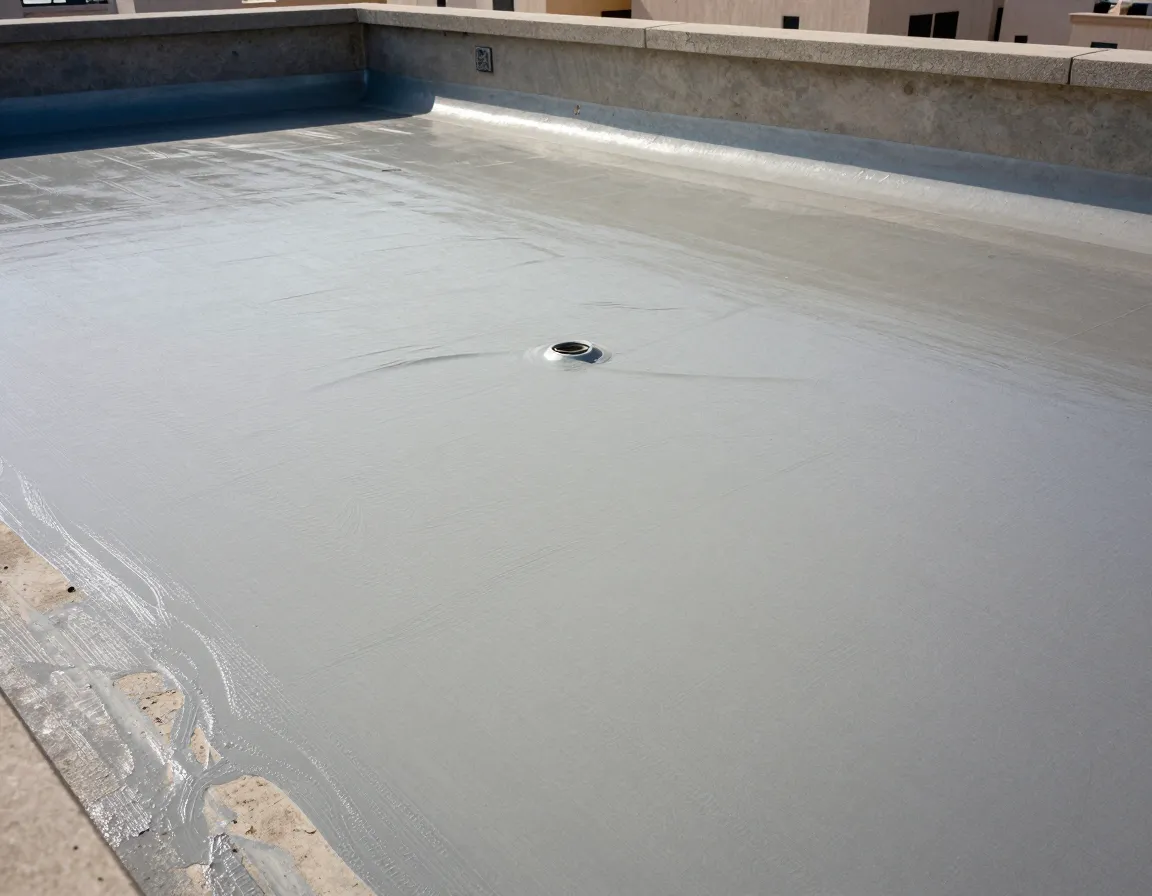
Watch a villa driveway interlock sub-base sink into ruts after one heavy winter downpour in Sharjah, Ajman, or Dubai—or inspect a French drain trench that stopped draining after six months—and the culprit is almost always a missing or mis-specified filter fleece. Either the contractor skipped the separation layer between the crushed roadbase and silty desert sand, or laid a cheap 100 g/m² polyester felt under angular gravel where a high-puncture non-woven geotextile UAE consultants specify (200 g/m² to 300 g/m² polypropylene) was required.
In the UAE, needle-punched non-woven geotextile membranes are specified and tested under GSO ISO 10319:2014 (Geosynthetics — Wide-width tensile test), GSO EN 13252:2011 (Geotextiles for drainage systems), GSO EN 13251:2011 (Geotextiles for earthworks, foundations and retaining structures), and ASTM D4632/D4632M (Grab Breaking Load and Elongation of Geotextiles). Here is how to select the exact 120 gsm to 500 gsm weight class, choose between Polyester (PET) and Polypropylene (PP) in alkaline concrete/soil environments, and calculate roll quantities including overlap allowances.
In This Guide
- Quick-Answer Cheat Sheet: UAE Non-Woven Geotextile GSM Grades & Uses
- 120 gsm to 500 gsm Non-Woven Geotextile Specification Table
- Polyester (PET) vs Polypropylene (PP) & Non-Woven vs Woven Geotextiles
- Worked UAE Quantity Calculation: Roof Separation & Sub-Surface Drainage Trench
- 5 Common Geotextile Mistakes on UAE Sites (And How to Avoid Them)
- Frequently Asked Questions (FAQs)
Quick-Answer Cheat Sheet: UAE Non-Woven Geotextile GSM Grades & Uses
- What “GSM” (g/m²) Means: Mass per unit area in grams per square metre (tested to ISO 9864 / ASTM D5261). Higher GSM delivers higher CBR puncture resistance and grab tensile strength.
- 120 gsm – 150 gsm Non-Woven Geotextile: Standard UAE grade for inverted/combo flat roof separation and filter layers (above and below XPS thermal insulation boards) and wrapping perforated uPVC agricultural/sub-soil drainage pipes.
- 200 gsm Non-Woven Geotextile: Medium-duty filtration and separation layer used under interlock paving sub-bases, villa driveways, artificial grass bases, and French drain gravel trenches.
- 250 gsm – 300 gsm Non-Woven Geotextile: Heavy-duty cushion and separation layer under compacted roadbase on soft silty/sabkha ground and over horizontal basement waterproofing membranes before pouring protection screeds.
- 400 gsm – 500 gsm Non-Woven Geotextile: Extra-heavy mechanical protection fleece protecting PVC/HDPE geomembranes and deep foundation tanking against sharp crushed aggregate puncture.
- Standard UAE Roll Sizes: Stocked in 2.0 m × 100 m (200 m²/roll) for easy two-man roof handling, and 4.0 m × 100 m (400 m²/roll) or 4.5 m × 100 m (450 m²/roll) for large earthworks and road sub-bases.
120 gsm to 500 gsm Non-Woven Geotextile Specification Table
When preparing a material submittal for a Dubai, Sharjah, or Abu Dhabi consultant, never specify geotextile by GSM weight alone—thermally bonded or short-staple recycled fabric has far lower strength than virgin continuous-filament needle-punched polypropylene of the same GSM. Always cross-check the mechanical and hydraulic values against GSO ISO 10319:2014 and ASTM D4632:
| Geotextile Grade (Mass / m²) | Wide-Width Tensile (GSO ISO 10319) | Grab Tensile Load (ASTM D4632) | CBR Puncture (ISO 12236) | Typical Roll Weight (2×100 m / 4×100 m) | Primary UAE Site Application |
|---|---|---|---|---|---|
| 120 g/m² (120 gsm) | ~6.0 – 8.0 kN/m | ~380 – 450 N | ~1,000 – 1,300 N | 24 kg / 48 kg | Top filter layer over roof XPS insulation before gravel/screed |
| 150 g/m² (150 gsm) | ~8.5 – 11.0 kN/m | ~500 – 620 N | ~1,500 – 1,850 N | 30 kg / 60 kg | Roof membrane separation layer & perforated drain pipe wrap |
| 200 g/m² (200 gsm) | ~12.0 – 14.5 kN/m | ~700 – 850 N | ~2,100 – 2,500 N | 40 kg / 80 kg | French drain gravel wrap, landscape planters & paver sub-base |
| 300 g/m² (300 gsm) | ~18.0 – 22.0 kN/m | ~1,100 – 1,300 N | ~3,200 – 3,800 N | 60 kg / 120 kg | Roadbase-to-subgrade separation & raft waterproofing cushion |
| 500 g/m² (500 gsm) | ~28.0 – 35.0 kN/m | ~1,800 – 2,200 N | ~5,200 – 6,000 N | 100 kg / 200 kg | Heavy protection over HDPE/PVC pond liners & deep basements |
Site & Chemical Warning: Polyester (PET) vs Polypropylene (PP) Under Wet Concrete Screeds
Standard Polyester (PET) non-woven geotextile is economical and performs well in neutral pH soil trenches or dry gravel roofs, but polyester fibres slowly degrade by hydrolysis when permanently saturated in high-alkaline water (pH > 10–11) leached from fresh OPC cement screeds or concrete blinding. Whenever a geotextile sits directly beneath wet cast-in-situ concrete, cement mortar beds, or aggressive coastal sabkha groundwater, specify 100% Virgin Polypropylene (PP) needle-punched geotextile, which is chemically inert from pH 2 to pH 13.
Polyester (PET) vs Polypropylene (PP) & Non-Woven vs Woven Geotextiles
Contractors often ask why non-woven felt is used on roofs and drains while woven slit-film fabric is specified under heavy crane pads:
- Needle-Punched Non-Woven Geotextile (Felt-Like Fleece): Manufactured by entangling random polymer fibres with barbed needles. It has high water permeability (50 to 110 L/m²·s normal to the plane under GSO EN 13252) and 40–60% elongation before break, allowing it to deform around sharp aggregate stones without puncturing while letting water pass freely and trapping fine silt particles.
- Woven Geotextile (Cross-Woven Polypropylene Tapes): Looks like heavy woven sacking. It delivers very high tensile strength at low elongation (ideal for basal soil reinforcement under embankments under GSO EN 13251), but its flat woven ribbons have low water permeability and poor cushioning thickness—making woven fabric unsuitable for French drain filtration or roof waterproofing protection.
Worked UAE Quantity Calculation: Roof Separation & Sub-Surface Drainage Trench
Here is how a Quantity Surveyor calculates the exact roll count of 150 gsm and 200 gsm non-woven geotextile for a villa project in Sharjah or Dubai alongside our Excavation Calculator:
Worked Example: 250 m² Inverted Villa Roof (2 Layers × 150 gsm) + 60 m Perimeter French Drain Trench (200 gsm)
Scope A — 250 m² Inverted Roof (Lower Separation Layer + Upper Filter Layer, 150 gsm, 2.0 m × 100 m = 200 m²/roll):
- Net Roof Area (2 Layers): 250 m² below XPS boards + 250 m² above XPS boards = 500.0 m² net.
- Overlap & Parapet Turn-Up Allowance: With a 150 mm longitudinal lap on a 2.0 m wide roll (effective width = 1.85 m) plus 150 mm perimeter turn-up and 5% cutting waste (+15% total factor): 500.0 m² × 1.15 = 575.0 m² gross → Order 3 rolls of 2.0 m × 100 m (150 gsm) Non-Woven Geotextile (600 m² total).
Scope B — 60 Linear Metres Perimeter Sub-Surface French Drain Trench (200 gsm, 0.60 m Wide × 0.80 m Deep Gravel Trench):
- Trench Wrap Perimeter per Linear Metre: Bottom (0.60 m) + 2 vertical sides (2 × 0.80 m = 1.60 m) + Top full width with 300 mm overlap (0.60 m + 0.30 m = 0.90 m) = 3.10 m unwrapped fabric width.
- Total Fabric Area (Including 300 mm End Laps = +6%): 60.0 m length × 3.10 m wrap width × 1.06 = 197.2 m² gross → Order 1 roll of 2.0 m × 100 m (200 gsm) Virgin PP Non-Woven Geotextile (200 m²) (or cut from a 4 m wide roll).
Commercial Note: Geotextile rolls in the UAE are priced per m² or per roll based on GSM weight (120 to 500 gsm) and polymer type (recycled PET vs virgin PP). Check your total invoice amount inclusive of tax using our UAE 5% VAT Calculator.
5 Common Geotextile Mistakes on UAE Sites (And How to Avoid Them)
- Skimping on Overlap Width Over Soft Coastal Sabkha Subgrades: While a 150 mm to 200 mm overlap is sufficient on a flat concrete roof deck, laying geotextile over soft, wet Sharjah or Dubai sabkha soil with only a 100 mm lap causes the sheets to pull apart as soon as the first dump truck tips crushed roadbase. Over soft soil (CBR < 3%), overlap adjacent rolls by 300 mm to 500 mm (or sew/pin the seams).
- Wrapping Muddy Perforated Drain Pipes Directly Without a Clean Gravel Envelope: If you wrap a 150 gsm geotextile sock tightly around a perforated uPVC pipe and backfill fine silty desert sand directly against the pipe, silt blinds the small perforations within months. Always bed the perforated pipe inside a 20–40 mm washed single-size drainage gravel trench and wrap the entire gravel trench envelope with the 200 gsm geotextile.
- Leaving Uncovered Geotextile Rolls Exposed to UAE Sunlight for Weeks: Polypropylene and polyester fibres lose up to 30–50% of their GSO ISO 10319 tensile strength if left uncovered under direct UAE summer UV radiation for more than 14 days. Store rolls in their black UV-protective outer plastic wrap off the ground and cover installed geotextile with aggregate, screed, or roof tiles within 48–72 hours.
- Driving Heavy Tracked Excavators or Skid-Steers Directly on Bare Geotextile: Turning a Bobcat or excavator track directly on exposed 200 gsm geotextile tears and bunches the fabric. Always dump aggregate onto the previously covered section and push the gravel forward over the geotextile with a minimum 150 mm compacted lift thickness before allowing plant wheels over it.
- Using Torch Flame or Solvent Bitumen to Tack Geotextile onto Roof Membranes: Never use a propane gas torch or hot bitumen to stick a non-woven geotextile separation fleece onto a 4 mm torch-on roof membrane—polypropylene melts at ~160°C and shrinks into brittle holes, defeating its purpose as a slip/separation layer. Lay the fleece loose and ballast the laps immediately, cutting cleanly with a sharp heavy-duty utility knife.

Frequently Asked Questions (FAQs)
What GSM of non-woven geotextile is used for UAE flat roofs?
For standard UAE inverted and combo flat roofs, consultants specify a 150 gsm to 200 gsm needle-punched non-woven geotextile as the lower cushion/separation layer between the 4 mm torch-on waterproofing membrane and the XPS thermal insulation boards, and a 120 gsm to 150 gsm non-woven filter geotextile on top of the XPS boards beneath the gravel ballast or protection screed.
What is the standard roll size of non-woven geotextile in the UAE?
Non-woven geotextile membranes in Dubai, Sharjah, and Ajman are stocked in two primary roll widths: 2.0 m wide × 100 m long (200 m² gross per roll), which is preferred for villa roofs, wet rooms, and narrow drainage trenches because two workers can carry it up stairs; and 4.0 m or 4.5 m wide × 100 m long (400 m² or 450 m² per roll) for large roadworks, car parks, and raft foundations.
What is the required overlap when laying non-woven geotextile rolls?
On flat, firm surfaces such as concrete roof slabs, PCC blinding, or XPS insulation boards, overlap adjacent geotextile rolls by a minimum of 150 mm to 200 mm. On earthworks subgrades, French drain trenches, and road sub-bases, overlap rolls by 300 mm on firm soil (CBR > 3%) and 450 mm to 500 mm on soft or wet sabkha subgrades.
Should I choose Polyester (PET) or Polypropylene (PP) non-woven geotextile?
Choose 100% Virgin Polypropylene (PP) non-woven geotextile whenever the fabric will be in contact with wet cement screeds, concrete blinding, lime-treated soils, or high-salinity groundwater, as PP resists high-alkaline conditions (pH 2–13) and offers higher filament strength per gram. Polyester (PET) non-woven geotextile is an economical option for dry gravel ballast roofs, general landscaping, and neutral-pH soil filtration.
Order 120 gsm to 500 gsm Non-Woven Geotextile Rolls in the UAE
Al Tashteb Al Saree Building Materials Trading (Bu Tina, Sharjah) supplies civil, roofing, and landscaping contractors across Sharjah, Ajman, and Dubai with 120 gsm, 150 gsm, 200 gsm, 300 gsm, and 500 gsm non-woven geotextile rolls (2×100 m & 4×100 m), waterproofing membranes & building chemicals, uPVC drainage pipes & fittings, and cement & masonry materials—all quoted transparently in AED incl. 5% VAT.